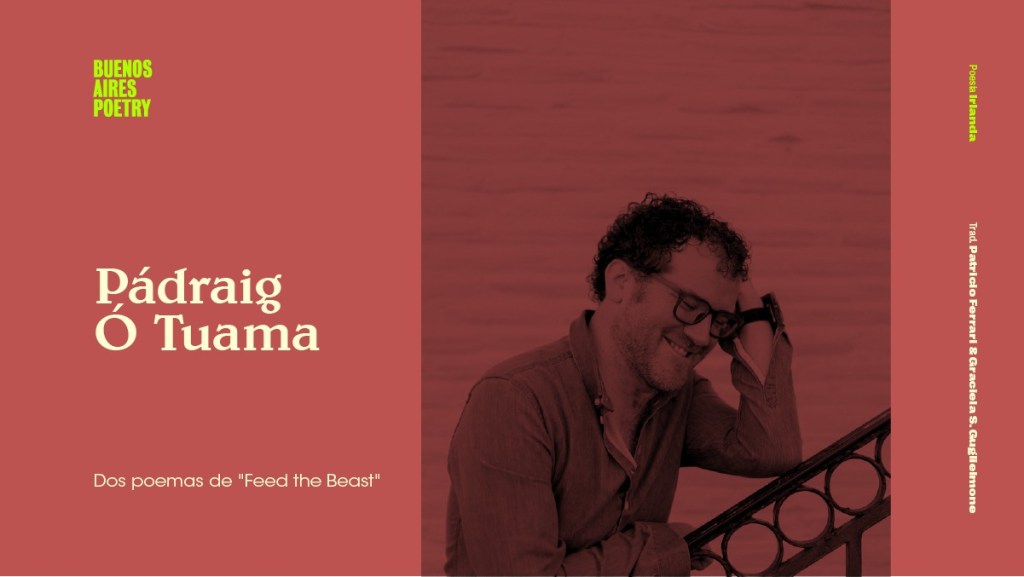
Pádraig Ó Tuama es un poeta y teólogo oriundo de County Cork, Irlanda. Presenta el podcast Poetry Unbound con On Being Studios, y sus libros más recientes son Feed the Beast (Broken Sleep Books, 2022) y Poetry Unbound: 50 Poems to Open Your World (Canongate, 2022). Kitchen Hymns, su nuevo poemario, se publicará en 2024. Sus anteriores poemarios fueron Sorry for your Troubles (Canterbury Press, 2013) y Readings from the Book of Exile (Canterbury Press 2012).
La poesía de Ó Tuama se ha publicado ampliamente en Irlanda, Reino Unido y Estados Unidos, en revistas literarias como Poetry Ireland Review, Harvard Review, New England Review of Books, Gutter y Kenyon Review. Además de poesía, ha publicado sobre teología y resolución de conflictos, especialmente en Borders & Belonging, en coautoría con Glenn Jordan (Canterbury Press, 2021). Cuenta con contribuciones en los libros When Did We See You Naked? (SCM Press, 2021) y Mapping Faith: Theologies of Migration and Community (Jessica Kingsley Publishers, 2020).
Con formación en resolución de conflictos y teología, Pádraig Ó Tuama es licenciado en teología por Maynooth y Queen’s University Belfast, y doctor en poesía y teología por la Universidad de Glasgow.
El carnicero del Edén
Y Dios hizo abrigos de pieles para Adán y Eva y los vistió.
— Génesis 3:21
Y cuando hubo concluido
raspó la grasa
del dorso de las pieles tensadas,
limpió la sangre,
cosió las costuras,
mordió el hilo con los dientes
y dijo:
Vístanse con esto.
Y ellos dijeron:
¿En qué consiste este verbo?
Dios clavó el cuchillo en la tierra y dijo:
Es como fingir
pero para el cuerpo.
Contemplaron toda la carne
aún humeante
de cuando estaba con vida.
Dios dijo: Coman.
Y miraron mientras
las bestias del Edén se alimentaban
de las bestias del Edén.
The Butcher of Eden
Now God made Adam and Eve coats of skins and dressed them.
— Genesis 3:21
And when he was finished,
he scraped fat
from the backs of stretched skins,
wiped the blood,
sewed the seams,
bit the thread with teeth
and
said:
Dress yourselves in these.
And they said:
what is this verb?
God shoved his knife into the earth, and said:
It’s like make believe
but for your body.
They looked at all the meat
still steaming
from when it was alive.
God said: Eat.
And watched while
beasts of Eden fed
on beasts of Eden.
Alimenta a la bestia
Antes cuando creía que Dios hablaría conmigo
Dios habló conmigo,
y me preguntó a quién
creía yo estar haciendo feliz.
Llevaba un ayuno de casi una semana,
alimentándome de grasa de fracaso de fe,
y una noche, rezando en lugar de comer,
adorando lo que desconocía,
Lo que DESCONOCÍA habló conmigo
diciéndome que alimentara mi hambre.
Yo tenía diecisiete años, o veinte, o cuarenta y cinco, o nueve
y el celo me devoraba vivo.
Cuando oí la voz yo estaba sentado en el suelo,
enroscado en torno a un instrumento musical.
Había librado la sala de imágenes
creyendo que leer y no comer bastaría.
Se oyó el sonido de mi estomago gruñendo.
Y el sonido de las uñas arañando las cuerdas de la guitarra.
Se oyó el sonido de lo que
hizo que esa bestia hambrienta comenzara a sentir.
Feed the Beast
Back when I believed God would speak to me
God spoke to me,
and asked me who
I thought I was keeping happy.
I was keeping a six day fast,
feeding on fat and faith and failure,
and one evening, praying instead of eating,
worshipping what I did not know,
What I Did Not Know spoke to me
telling me to feed my hunger.
I was seventeen, or twenty, or forty-five, or nine
and zeal was eating me alive.
When I heard the voice, I was sitting the ground,
wrapped around an instrument.
I had rid the room of imagery
believing that reading and not eating would be enough.
There was the sound of my stomach growling.
And the sound of nails scratching strings on a guitar.
There was the sound of whatever
made that starving beast start feeling.
Extraído de Pádraig Ó Tuama, Feed the Beast [Alimenta a la bestia], Cornwall: Broken Sleep Books Ltd, 2022 | Traducción de Patricio Ferrari & Graciela S. Guglielmone | Buenos Aires Poetry 2023 | Imagen: David Pugh padraigotuama.com/bio
 Buenos Aires Poetry