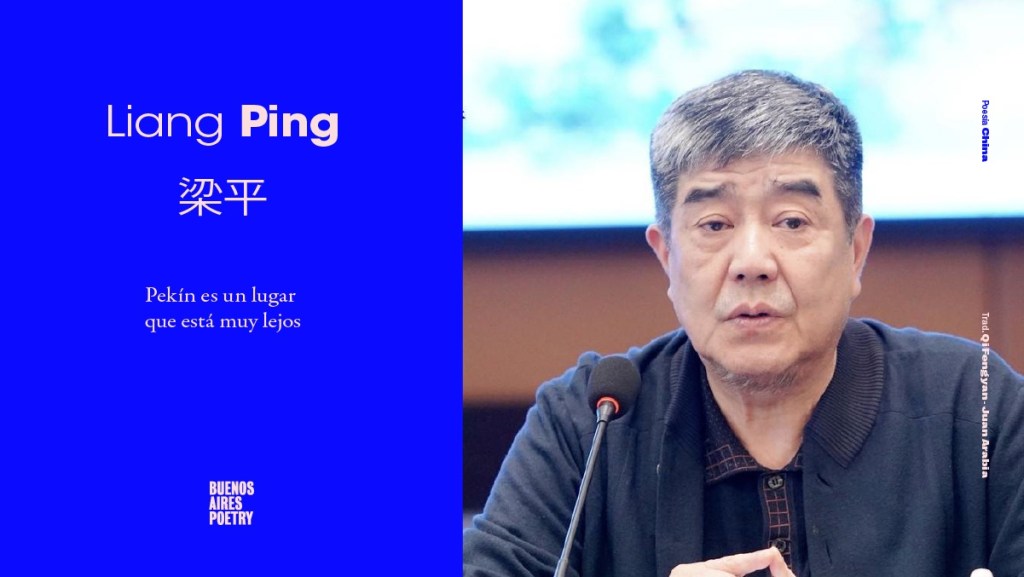
Poeta y escritor chino contemporáneo, Liang Ping 梁平 ha publicado once colecciones de poesía, como Selected Poems of Liang Ping 《梁平诗选》, Ba & Shu: Two Duets 《巴与蜀:两个二重奏》, Thirty Years on the East Side of the River 《三十年河东》, y Genealogy 《家谱》, así como colecciones de ensayos y crítica literaria 《子在川上曰》y 《阅读的姿势》. Sus obras han sido traducidas y presentadas en Estados Unidos, Gran Bretaña, Francia, Alemania, Japón, Corea del Sur, Rusia, Polonia, Bulgaria y otros países. Ha ganado el segundo premio especial del libro de China, el premio de poesía del escritor chino Guo Moruo, el premio de literatura de octubre, el premio de literatura de Sichuan y el premio de literatura Bashu, entre otros. Liang Ping es miembro del Comité Nacional de la Asociación de Escritores de China, subdirector del Comité de Poesía de la Asociación de Escritores de China, vicepresidente de la Asociación de Escritores de Sichuan, presidente de la Federación de Círculos Literarios y Artísticos de Chengdu y presidente del Instituto de Investigación de Poesía China de la Universidad de Sichuan.
Poet and writer, Liang Ping 梁平 has published eleven collections of poems, such as Selected Poems of Liang Ping, Ba & Shu: Two Duets, Thirty Years on the East Side of the River, and Genealogy, as well as one essay collection By the River Speaks the Master, one poetry review collection Posture of Reading. His works have been translated and introduced to the United States, Britain, France, Germany, Japan, South Korea, Russia, Poland, Bulgaria and other countries. He has won the 2nd China Book Special Prize, Chinese Writer Guo Moruo Poetry Prize, October Literature Prize, Sichuan Literature Prize, and Bashu Literature Prize and so on. Liang Ping is a member of the National Committee of China Writers’ Association, deputy director of the Poetry Committee of China Writers’ Association, vice chairman of the Sichuan Writers’ Association, chairman of the Chengdu Federation of Literary & Art Circles, and president of the Chinese Poetry Research Institute of Sichuan University.
Pekín es un lugar que está muy lejos
Pekín está muy lejos.
A veces, en el silencio de la noche de Chengdu,
preguntándome qué tan lejos está,
empiezo a contar como en el insomnio,
hasta que ya no puedo contar con claridad y me confundo.
Empiezo a contar desde el primer anillo,
y cuando llego al anillo doscientos cincuenta,
sigo despierto, viendo
la Puerta de Tiananmén, el Monumento a los Héroes del Pueblo,
eunucos y doncellas saliendo de la Ciudad Prohibida.
Estoy seguro de que los conozco,
pero ellos no me conocen.
Camino y sigo, exhausto,
Pekín realmente está muy lejos.
October 20, 2017
Beijing Is A Place Far Away¹
Beijing is far away.
Sometimes in the dead still of Chengdu’s night,
Wondering how far it is, I begin counting like in insomnia,
Until I can’t count clearly and get confused.
I start counting from the first ring,
When arriving at the two-hundred-fiftieth ring,
I’m still wide awake,
Seeing the Tiananmen Gate, the People’s Heroes Monument,
Eunuchs and maidens walking out of the Forbidden City.
I’m sure I know them,
But they don’t know me.
I walk on and on, exhausted,
Beijing is really far away.
October 20, 2017
北京是一个遥远的
地方北京很遥远,
我在成都夜深人静的时候,
曾经想过它究竟有多远?
就像失眠从一开始数数,
数到数不清楚就迷迷糊糊了。
我从一环路往外数,
数到二百五十环还格外清醒,
仿佛看见了天安门、人民英雄纪念碑,
看见故宫里走出太监和丫鬟,
我确定我认识他们,
而他们不认识我。
于是继续向外,走得精疲力尽,
北京真的很遥远。
2017/10/20 Beijing
¹ Translated by Qi Fengyan (born in Shenyang, Liaoning province in 1970’s. Some of her poems, essays and literature review articles have been published on journals and newspapers).
Poesía China | Traducción de Qi Fengyan / Juan Arabia | Buenos Aires Poetry 2023
 Buenos Aires Poetry