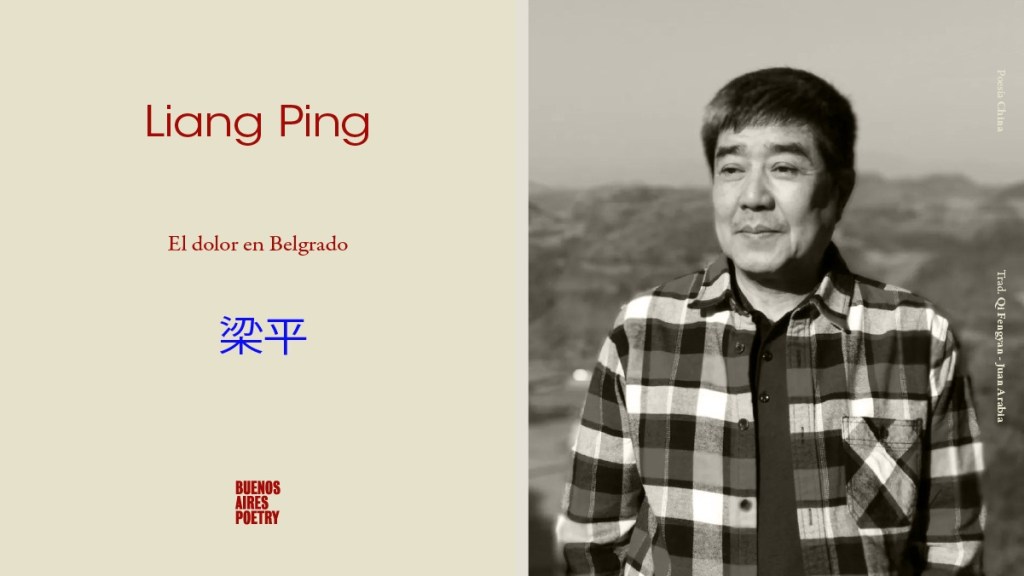
Poeta y escritor chino contemporáneo, Liang Ping 梁平 ha publicado once colecciones de poesía, como Selected Poems of Liang Ping 《梁平诗选》, Ba & Shu: Two Duets 《巴与蜀:两个二重奏》, Thirty Years on the East Side of the River 《三十年河东》, y Genealogy 《家谱》, así como colecciones de ensayos y crítica literaria 《子在川上曰》y 《阅读的姿势》. Sus obras han sido traducidas y presentadas en Estados Unidos, Gran Bretaña, Francia, Alemania, Japón, Corea del Sur, Rusia, Polonia, Bulgaria y otros países. Ha ganado el segundo premio especial del libro de China, el premio de poesía del escritor chino Guo Moruo, el premio de literatura de octubre, el premio de literatura de Sichuan y el premio de literatura Bashu, entre otros. Liang Ping es miembro del Comité Nacional de la Asociación de Escritores de China, subdirector del Comité de Poesía de la Asociación de Escritores de China, vicepresidente de la Asociación de Escritores de Sichuan, presidente de la Federación de Círculos Literarios y Artísticos de Chengdu y presidente del Instituto de Investigación de Poesía China de la Universidad de Sichuan.
Poet and writer, Liang Ping 梁平 has published eleven collections of poems, such as Selected Poems of Liang Ping, Ba & Shu: Two Duets, Thirty Years on the East Side of the River, and Genealogy, as well as one essay collection By the River Speaks the Master, one poetry review collection Posture of Reading. His works have been translated and introduced to the United States, Britain, France, Germany, Japan, South Korea, Russia, Poland, Bulgaria and other countries. He has won the 2nd China Book Special Prize, Chinese Writer Guo Moruo Poetry Prize, October Literature Prize, Sichuan Literature Prize, and Bashu Literature Prize and so on.Liang Ping is a member of the National Committee of China Writers’ Association, deputy director of the Poetry Committee of China Writers’ Association, vice chairman of the Sichuan Writers’ Association, chairman of the Chengdu Federation of Literary & Art Circles, and president of the Chinese Poetry Research Institute of Sichuan University.
El dolor en Belgrado
Yugoslavia había desaparecido,
la antigua embajada china fue derribada.
En la esquina de una obra, un bloque de mármol,
abstraído en un humor negro.
Una inscripción, los nombres de dos jóvenes,
resultaban más desolados que la vida.
Estaba lloviznando,
algunas flores marchitas estaban cubiertas de lágrimas,
cuyo color amarillo sombrío era particularmente deslumbrante.
Ninguna palabra pronunció el mármol desprotegido,
nadie se detuvo, nadie lo miró.
Belgrado se hallaba inexpresivo,
su memoria era más corta que la de un pez.
Me agaché para escuchar los disparos de ese año,
volando a través del océano y cayendo a un sótano con precisión.
He viajado un largo camino desde mi tierra,
y aquí no puedo ver el azul del río Danubio.
Con cuidado limpié la inscripción,
tierra fangosa, ramas y hojas desordenadas,
temeroso de que mi abrumadora tristeza toque su dolor.
3 de agosto de 2018
The Pain in Belgrade¹
Yugoslavia was gone,
The former Chinese Embassy was torn down.
At the corner of a building site, a block of marble,
Was as if in black humor.
An inscription and two young men’s names
Stood there more desolate than life.
It was drizzling,
Some wilted flowers were covered with tears,
Whose bleak yellow was particularly dazzling.
No word the unsheltered marble spoke,
No one stopped, nor at it looked.
Belgrade was expressionless,
Its memory was shorter than fish.
I crouched down to hear the gunfire of that year,
A missile flying across the ocean hitting a basement precisely.
I came all the way from my country,
But the blue of the Danube couldn’t be seen here.
Carefully I wiped off the inscription
Muddy earth, messy branches and leaves,
Afraid of my tumult of sorrow touching its pain.
August 3, 2018
在贝尔格莱德的痛
在贝尔格莱德的痛南斯拉夫没了,
中国大使馆的旧址拆了,
建筑工地一角,一块大理石,
像是正在被黑色幽默。
一段碑铭,两个年轻人的名字,
比生命站得更凄冷。
天下着细雨,几束枯萎的野花挂满泪珠,
那惨淡的黄,格外刺眼。
没有遮挡的大理石不说话,
没人驻足,没人多看它一眼。
贝尔格莱德面无表情,
比鱼的记忆更短暂。
我蹲下身去,听那年的炮火,
跨洋飞落地下室的精准。
我从我的祖国远渡而来,
在这里看不见多瑙河的蔚蓝,
只能小心翼翼地擦拭,
碑铭上的泥泞、凌乱的枝叶,
害怕我翻江倒海的伤感,
触碰到它的痛。
2018/8/3
¹ Translated by Qi Fengyan (born in Shenyang, Liaoning province in 1970’s. Some of her poems, essays and literature review articles have been published on journals and newspapers).
Poesía China | Traducción de Qi Fengyan / Juan Arabia | Buenos Aires Poetry 2023
 Buenos Aires Poetry