
El último haiku de Masaoka Shiki
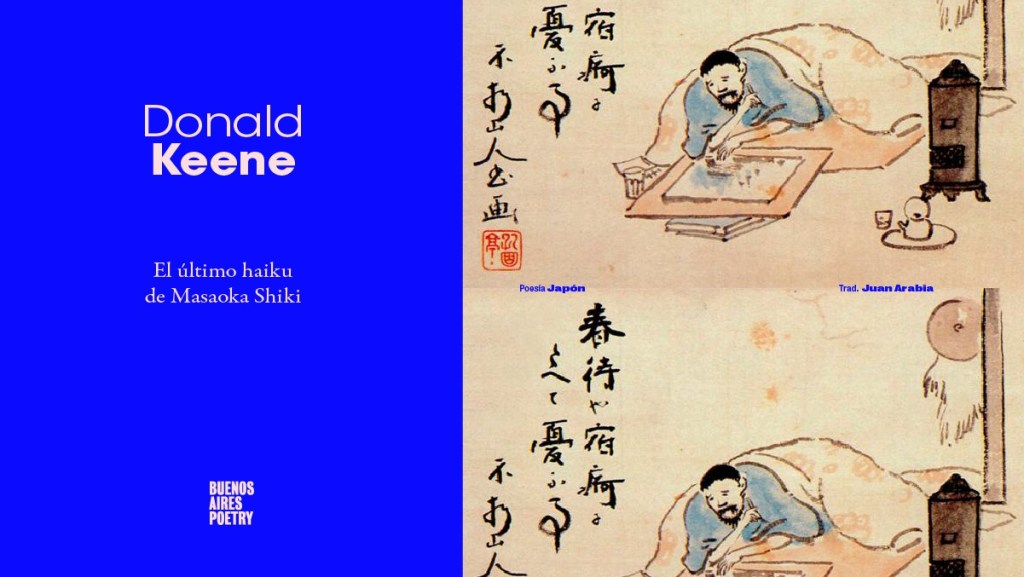
Shiki compuso sus últimos tres haiku la mañana del 18 de septiembre. Los garabateó en una hoja de papel que normalmente usaba para sus pinturas. Su hermana Ritsu sostuvo el tenso papel sobre una mesa de dibujo. Shiki no dijo nada mientras escribía, ahogado por la flema. Nadie más pronunció una palabra; los únicos sonidos eran las toses ocasionales del enfermo. El primero de los tres haiku que Shiki escribió en esta ocasión sería conocido como su jisei, o “adiós al mundo”;
La luffa ha florecido;
mira al Buda
lleno de flema.
Shiki se ve a sí mismo como un Buda (un hombre muerto), pero aunque ésta fue su despedida del mundo, contiene un toque de humor, la incongruencia de un Buda ahogado por la flema. Shiki hizo una pausa después de escribir cada línea de este poema y antes de cada uno de los dos últimos haiku. Cuando hubo terminado el tercero, dejó caer el pincel, aparentemente agotado por el esfuerzo. Ritsu apoyó el tablero de dibujo contra la pared para que otros en la habitación pudieran leer los poemas.
A partir de entonces, Shiki sólo emitió gemidos de dolor. Una dosis de morfina no logró aliviar su sufrimiento. El médico, que llegó más tarde, tras algunas dudas le dio a Shiki otra inyección de morfina. Esto alivió el dolor y le permitió dormir; pero la doble dosis pudo haber precipitado la muerte de Shiki.
Shiki murió temprano en la mañana del 19 de septiembre de 1902. Tenía treinta y cinco años. Hekigoto, junto con Ritsu, lavó el cadáver y lo envolvió en sábanas. Las memorias de Hekigito describen el horrible estado del cuerpo de Shiki: después de siete años de confinamiento en un lecho de enfermo, sólo la mitad superior del cuerpo de Shiki parecía estar viva.
The last haiku of Masaoka Shiki
Donald Keene
Shiki composed his last three haiku on the morning of September 18. He scrawled them on a sheet of the paper he normally used for his paintings. His sister Ritsu held the paper taut on a drawing board. Shiki said nothing as he wrote, choked by phlegm. No one else spoke a word; the only sounds were the occasional coughs of the sick man. The first of the three haiku that Shiki wrote on this occasion would be known as his jisei, or “farewell to the world”;
The sponge gourd has bloomed;
See the Buddha
Stuffed with phlegm,
Shiki sees himself as a Buddha (a dead man), but even though this was his farewell to the world, it contains a touch of haiku humor, the incongruity of a Buddha being choked by phlegm. Shiki paused after writing each line of this haiku and before each of the final two haiku. When he had finished the third, he let the brush drop, apparently exhausted by the effort. Ritsu leaned the drawing board against the wall so that others in the room could read the poems.
From then on, Shiki uttered only groans of pain. A dose of morphine failed to relieve his suffering. The doctor, who arrived later, after some hesitation gave Shiki another injection of morphine. This eased the pain and enabled him to sleep; but the double dose may have precipitated Shiki’s death.
Shiki died early in the morning of September 19, 1902. He was thirty-five years old. Hekigoto, together with Ritsu, washed the corpse and wrapped it in sheets. Hekigito’s memoir describes the horrifying state of Shiki’s body: after seven years of confinement to a sickbed, only upper half of Shiki’s body seemed to be alive.
hechima saite
tan no tsumarishi
hotoke kana
糸瓜咲いて痰のつまりし仏かな
Extraído de Donald Keene, The winter sun shines : a life of Masaoka Shiki, Columbia University Press, New York, 2013, pp. 188-189 | Traducción de Juan Arabia | Buenos Aires Poetry 2023

> Acceso al archivo digital de la revista
> Newsletters y notificaciones de últimas publicaciones por correo
By subscribing, you help Buenos Aires Poetry to keep relevant and independent.
> Access to the magazine’s digital archive
> Newsletters and latest post notifications by email
 Buenos Aires Poetry